Why a Hot Drink Warms You for Less Time Than You Think
Quick Answer: A large mug of hot tea delivers a genuinely small amount of heat relative to your body’s heat production, and your body offsets much of it anyway. Almost all of the warm feeling comes from thermoreceptors in the mouth and throat, from your hands on the mug, and from a brief comfort-driven relaxation. That is a real experience and a short one - typically 10 to 20 minutes. If you want sustained warmth, food, movement and a hat do more, and the drink is best treated as a comfort ritual that happens to be pleasant.
You make the tea specifically because you are cold.
Twenty minutes later you are still cold, holding a cool mug, and vaguely puzzled about where the warmth went.

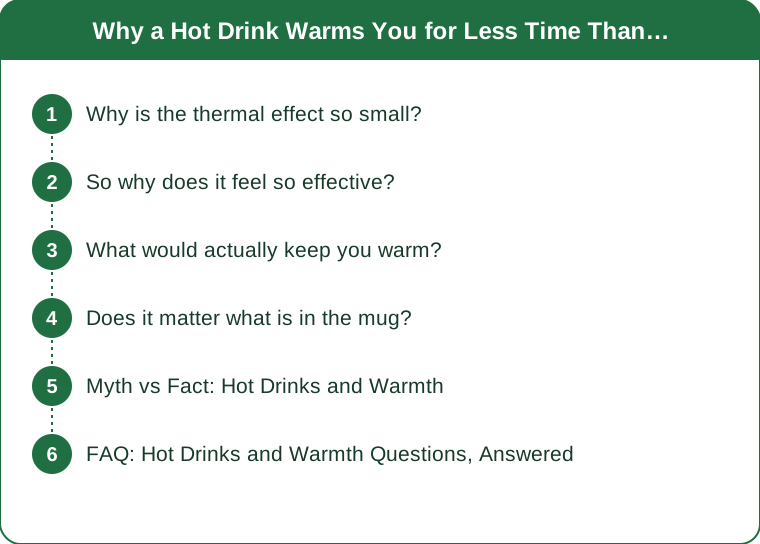
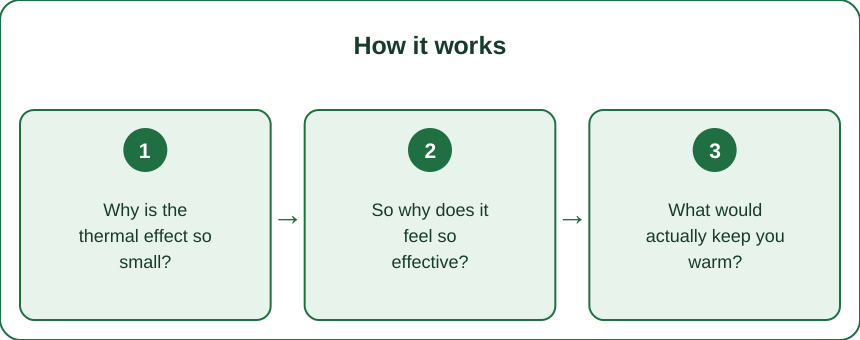
Why is the thermal effect so small?
The heat energy in a mug of tea is modest compared to what your body produces continuously through metabolism.
It gets distributed across your whole body mass, which means the actual temperature change is fractionally small.
Your thermoregulatory system responds to the input, and the response includes some peripheral vasodilation that sheds heat.
Which is why some research finds hot drinks can slightly increase overall heat loss in certain conditions, particularly when you can sweat freely.
The effect is real and it is short. Ten to twenty minutes of feeling warmer is about the honest range.
And that is fine - it just means the drink is a comfort intervention rather than a heating one.
So why does it feel so effective?
Thermoreceptors in the mouth, throat and oesophagus fire strongly, and your perception of warmth comes largely from these sensors rather than from core temperature.
Your hands are extremely sensitive to temperature and are usually the coldest part of you, so wrapping them around a mug produces a disproportionate sense of warmth.
The pause matters. Making and drinking something warm involves stopping, which lets tension drop, and relaxation feels warm.
Steam on the face adds another warmth signal in a highly sensitive area.
Expectation contributes genuinely, and comfort effects are real experiences rather than illusions.
Which means most of what you are getting is sensory and psychological, and that is worth having on a cold afternoon.
What would actually keep you warm?
Food, particularly with some protein and fat, since digestion raises metabolic heat production for a sustained period rather than minutes.
Movement. Five minutes of walking or stairs produces far more heat than any drink and keeps producing it afterward.
A hat and warm socks, since heat loss from the head and the extremities is where you are actually losing it.
Insulating your feet from a cold floor, which is the most common unnoticed source of feeling cold indoors.
Layers with a windproof outer if you are outdoors, since wind is what makes autumn air bite.
And a warm drink alongside all of that, which is a fine addition to a working strategy and a poor substitute for one.

Does it matter what is in the mug?
Caffeine has a mild thermogenic effect but also mild diuretic and vasoconstrictive properties, so it is not the deciding factor.
Ginger, cinnamon and chilli produce a warming sensation through receptor activation rather than actual heat, which is the same sensory mechanism at a different site.
Sugar and calories give you something to burn, which is why hot chocolate genuinely outperforms black tea on a cold walk.
Broth adds sodium and fluid and tends to be more satisfying in cold weather than sweet drinks.
Alcohol feels warming and is not - it dilates peripheral vessels, which increases heat loss while making you feel warmer, and that combination is why it is a poor choice outdoors in cold weather.
And temperature above about 140F adds no benefit and risks burns, so hot rather than scalding is the sensible target.
Myth vs Fact: Hot Drinks and Warmth
Myth: a hot drink raises your core temperature meaningfully.
Fact: the change is fractionally small and short-lived. Your perception of warmth comes from thermoreceptors in the mouth and hands, not from a measurable core change.
Myth: hot drinks are the best thing when you come in from the cold.
Fact: a warm drink plus food plus dry clothes is the combination. The drink is the least effective of the three and the one people rely on most.
Myth: a hot toddy is good for warming up outdoors.
Fact: alcohol increases peripheral blood flow, which accelerates heat loss while making you feel warmer. That combination is genuinely risky in cold conditions.
Myth: cold drinks make you colder.
Fact: the effect is symmetrical and equally small. A cold drink on a cold day is not doing meaningful thermal damage - it just feels less pleasant.
Myth: herbal warming spices actually generate heat.
Fact: ginger, cinnamon and chilli activate the same receptor family that detects heat, which produces a warming sensation without producing warmth. It is a real sensation and not a thermal contribution.
FAQ: Hot Drinks and Warmth Questions, Answered
How long does the warm feeling last?
Typically 10 to 20 minutes, driven mostly by mouth and hand thermoreceptors rather than any lasting temperature change.
Is soup better than tea for warmth?
Yes, meaningfully. The calories and protein produce sustained metabolic heat that a calorie-free drink cannot.
Does caffeine help or hurt in the cold?
Mild thermogenic effect, mild vasoconstriction, and a diuretic effect at higher intakes. Broadly neutral, and not a reason to choose or avoid it.
Why do my hands feel so much warmer holding a mug?
Hands have a very high density of temperature receptors and are usually your coldest body part, so direct contact with a warm surface produces a large sensory response.
Is it bad to drink very hot liquids?
Repeatedly drinking very hot beverages has been associated with oesophageal irritation. Letting a drink cool below scalding is the sensible habit.
What is the single best thing for feeling cold indoors?
Warm feet. Insulating from a cold floor and wearing proper socks changes whole-body comfort more than almost anything else.
This is general information, not medical advice.
TL;DR:
- The heat energy in a mug is tiny relative to your metabolism, and your body offsets much of it.
- The warm feeling comes from mouth and hand thermoreceptors plus the pause, and lasts 10 to 20 minutes.
- Food, movement, a hat and warm feet do the sustained work.
- Soup and hot chocolate genuinely outperform calorie-free drinks in the cold.
- Alcohol feels warming while increasing heat loss - a poor choice outdoors.
The mug is a comfort ritual. Treat it as one and it never disappoints.
Keep Reading
This article is for general informational purposes only and is not medical advice. Always consult a qualified health professional for guidance specific to you.