Why Electrolyte Drinks Taste Different When You Are Not Dehydrated
Quick Answer: Salt preference is state-dependent. When you are sodium-depleted, salty drinks taste noticeably better and less intense — a phenomenon linked to the body’s sodium appetite. Rehydrated and at rest, the same concentration registers as unpleasantly salty. The drink did not change; your internal reference point did.
After a long hot session it tastes like exactly what you wanted.
The same sachet in the same water at your desk on a Tuesday tastes like seawater and you tip half of it out.
That is not inconsistency. It is one of the more reliable demonstrations that taste is not a fixed property of a liquid.

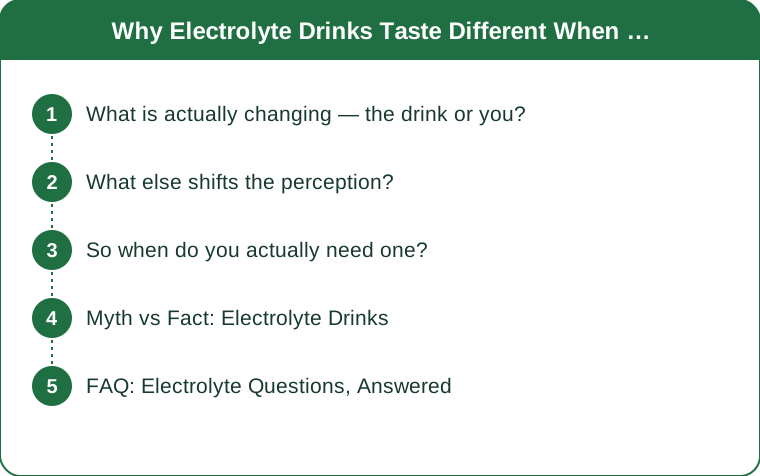
What is actually changing — the drink or you?
You are, and the effect has been studied for decades.
Humans and other animals show a sodium appetite: when sodium status drops, preference for salty tastes rises. Sodium-depleted people rate salty solutions as more pleasant and often as less intense than the same solutions rated in a replete state.
The mechanism runs through the systems that regulate fluid balance — the same hormonal machinery that manages sodium retention appears to influence how rewarding salt tastes. It is a control loop: when you need salt, salt becomes attractive, and when you do not, it stops being attractive.
This is why the effect is so clean with electrolyte drinks specifically. A typical serving contains a substantial amount of sodium, well above what you would tolerate in a beverage at rest. After you have sweated for ninety minutes, that same concentration reads as balanced, or even mild.
The practical implication is genuinely useful: your taste response is weak evidence about your own status. If an electrolyte drink tastes too salty to finish, you probably did not need it.
What else shifts the perception?
Several things, and they compound with the sodium effect.
Temperature. Cold suppresses perceived sweetness much more than it suppresses saltiness. A warm electrolyte drink tastes sweeter and rounder; the same drink over ice tastes sharper and saltier. Sports drinks are formulated to be consumed cold for exactly this reason.
Dry mouth. Dehydration reduces saliva, and saliva contains sodium that your tongue is calibrated against. Less saliva means a different baseline, which changes how salt registers before any hormonal effect is involved.
Effort and heat. Exercise itself changes taste perception, with preferences generally shifting toward more concentrated and more savory options during and immediately after hard work. This is part of why plain water can feel unsatisfying after a hard hot session even when it is exactly what you need.
Concentration relative to your own sweat. People vary a lot in how salty their sweat is — a range often cited from roughly 200 to over 1,000 mg of sodium per liter. Heavy salty sweaters genuinely need more and generally tolerate stronger drinks better, at rest as well as after training.
What you ate. A high-sodium meal shifts the baseline for hours. An electrolyte drink after a salty lunch will taste stronger than the same drink on an empty stomach.

So when do you actually need one?
Less often than the marketing implies, and more often than the skeptics claim.
You probably do need electrolytes when: you have exercised hard for more than about 60 to 90 minutes, especially in heat; you are a visibly heavy or salty sweater (white marks on clothing and skin); you have been sweating repeatedly across a day; or you are dealing with fluid loss from illness.
You probably do not when: the session was under an hour in mild conditions; you are sitting at a desk; or you are drinking one because it is a habit. In those cases water plus normal meals covers it comfortably — a typical diet supplies far more sodium than most people lose in a light workout.
The fall-specific note: people often keep the summer habit into cooler weather while sweat losses drop substantially. If your electrolyte drink has started tasting too salty in September, that is a reasonable signal to reduce the concentration or the frequency.
What to look for if you do use them: the sodium content is the number that matters most, and products vary from around 200 mg to over 1,000 mg per serving. Match it to your losses, not to the strongest option available. Potassium and magnesium are present in much smaller amounts and matter less for acute rehydration than the marketing suggests.
And a practical trick: if a drink tastes too strong, dilute it and drink more of it. You get the same sodium, better palatability, and better fluid intake — which is usually the actual goal.
Myth vs Fact: Electrolyte Drinks
Myth: If it tastes good, you needed it. Fact: That is roughly backwards as a rule of thumb, and it is also one of the more interesting things about the effect — tasting good is evidence you were depleted, which is information after the fact, not a reason to drink more.
Myth: More electrolytes are always better. Fact: Very high sodium concentrations can slow gastric emptying and cause GI discomfort during exercise. Formulations exist in a fairly narrow effective range for a reason.
Myth: You need electrolytes for any workout. Fact: For sessions under an hour in moderate conditions, water is sufficient for the vast majority of people. Normal food replaces what you lost.
Myth: Clear urine means well hydrated. Fact: Completely clear urine often means you are drinking more water than you need, which can dilute sodium. Pale yellow is the usual target.
Myth: Coconut water is a complete electrolyte replacement. Fact: It is high in potassium and relatively low in sodium, and sodium is the electrolyte lost in the largest quantity in sweat. It is a pleasant drink, not a rehydration solution.
FAQ: Electrolyte Questions, Answered
Can I just add salt to water?
Yes — roughly a quarter teaspoon of table salt per liter lands in a reasonable range, and adding a little juice makes it drinkable. Commercial products mostly buy you convenience and taste rather than superior chemistry.
Why do some people crave salt after exercise?
That is the same sodium appetite mechanism, expressed as a craving rather than as a taste preference. It is generally a reasonable signal after prolonged sweating.
Is there a downside to drinking them when I do not need them?
Mostly unnecessary sodium and, in sweetened versions, unnecessary calories. For most healthy people an occasional extra serving is not a concern, but anyone managing blood pressure or kidney issues should treat added sodium deliberately. This is general information, not medical advice.
Does the taste effect work in reverse for sweet drinks?
Somewhat — preference for carbohydrate also shifts with energy status, which is why a sports drink tastes better at the end of a long session than at the start. The sodium effect is the more dramatic of the two.
Should I use them for a hangover?
Rehydration helps, and there is nothing magic about the electrolyte version beyond getting fluid and sodium in. Whether it beats water plus a normal meal is largely down to what you will actually drink.
TL;DR:
- Salt preference is state-dependent — depleted, salty drinks taste better and milder; replete, the same drink tastes harsh.
- Cold suppresses sweetness more than saltiness, and dry mouth shifts your baseline, so both amplify the effect.
- A drink that tastes too salty to finish is decent evidence you did not need it.
- Most sessions under an hour need water only; look at sodium content and match it to your actual losses.
- If it tastes too strong, dilute it and drink more — same sodium, better fluid intake.
The formula never changed between August and October. Your sodium status did, and your tongue reports on that faithfully.
Keep Reading
This article is for general informational purposes only and is not medical advice. Always consult a qualified health professional for guidance specific to you.