Why Your Iced Wellness Drink Tastes Weaker by the Third Sip
Quick Answer: A standard glass of ice dilutes a drink by roughly 20 to 30 percent by the time you finish it, and most of that happens in the first 10 minutes when the temperature gap is largest. That changes not just strength but the balance between compounds — bitterness, salt, and aromatics fade at different rates. The fixes are simple: brew or mix at higher concentration for iced serving, use fewer and larger ice cubes, chill the liquid before it meets ice, and freeze part of the drink itself into cubes.
The first sip is perfect. By the third it is fine. By the time you get back to your desk it tastes like tea-flavored water.

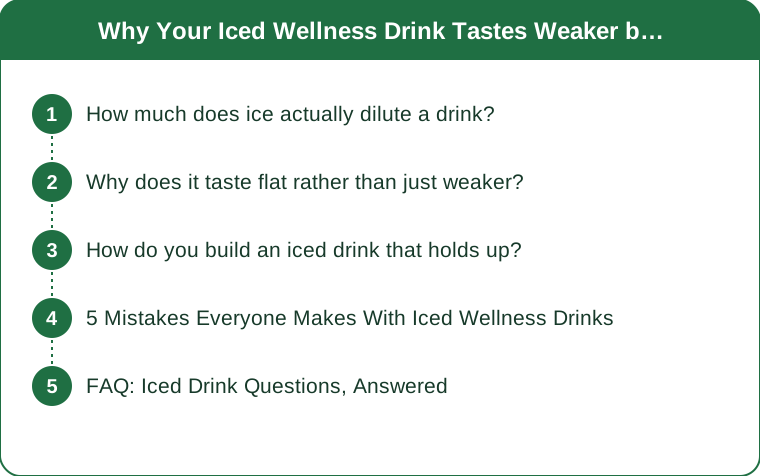
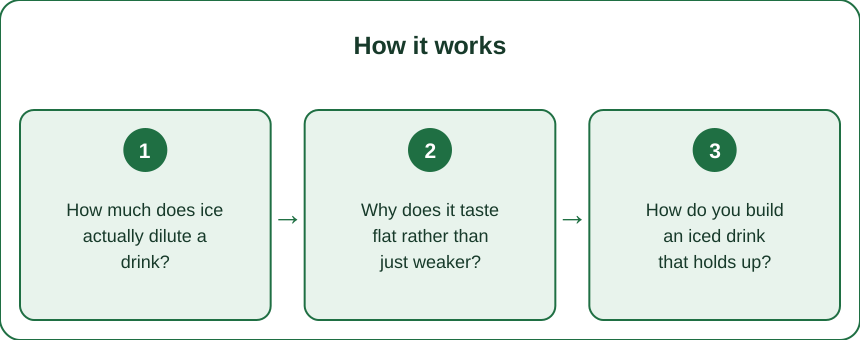
How much does ice actually dilute a drink?
More than most people estimate. Melting ice requires a large amount of energy — the heat of fusion — and that energy comes from the drink itself. Chilling a room-temperature liquid to a properly cold drinking temperature costs you real volume.
In practice, a glass filled with standard small cubes and a room-temperature liquid poured over it ends up 20 to 30 percent water by the time the glass is empty, and considerably more if the drink sits.
The rate is not steady. Melting is fastest when the temperature difference is largest, so most of the dilution happens in the first 10 minutes. That is exactly the window where you take the first few sips and form your impression, and then the drink keeps sliding.
Surface area drives the rest. Ten small cubes have far more total surface than three large ones at the same volume, which is why bar-style large cubes exist. They are not decorative, they are slower.
Why does it taste flat rather than just weaker?
Because dilution is not uniform in how you perceive it.
Bitterness and astringency drop fast and noticeably. In a matcha or a strong tea, the catechins and tannins that give structure fade first, which is why an iced tea can go from balanced to thin without becoming obviously watery.
Salt perception falls off a cliff. Electrolyte drinks depend on a fairly narrow sodium concentration to taste correct, and a 25 percent dilution takes them from refreshing to strangely flat.
Aromatics escape rather than dilute. Volatile compounds in citrus, mint, ginger, and coffee evaporate over time regardless of ice, so a drink loses its top notes on a separate clock from its body.
Sweetness masks the change. A sweetened drink hides dilution far longer than an unsweetened one, which is why unsweetened iced matcha and plain iced green tea are the drinks people complain about most.
So the drink does not become a weaker version of itself. It becomes a differently balanced drink, and usually a worse one.

How do you build an iced drink that holds up?
Four techniques, roughly in order of how much they help.
1. Brew or mix stronger, on purpose. For iced tea or matcha, use about 1.5 times the usual amount of tea for the same final volume. This is standard practice in cafes and it is the single biggest improvement. For electrolyte mixes, mix to the low end of the water range on the label.
2. Freeze the drink itself. Make ice cubes out of brewed tea, coffee, or coconut water. They dilute into more of the same thing instead of into water. A tray takes five minutes and lasts a week.
3. Chill before you pour. A liquid that goes into the glass already cold has a far smaller temperature gap to close, so the ice barely melts. Brew and refrigerate the night before rather than brewing hot and pouring over ice.
4. Use fewer, bigger cubes. Counterintuitive but correct — a glass packed with large cubes stays colder and dilutes slower than one with a few small ones, because more total ice mass with less surface area means slower melting and better temperature holding.
5 Mistakes Everyone Makes With Iced Wellness Drinks
1. Pouring hot liquid straight over ice. Half the ice is gone before you take a sip, and the drink is diluted at the exact moment it should be strongest. Chill first, or use the double-strength method.
2. Adding powders to an already-iced glass. Cold water dissolves powders poorly. Collagen, electrolyte mixes, and greens powders should go into a small amount of room-temperature liquid first, then over ice. Otherwise you drink a clear glass and eat the last inch.
3. Using the office freezer ice. Ice absorbs odors from a freezer aggressively. Old ice in a shared freezer will make an expensive matcha taste like whatever is next to it.
4. Squeezing citrus in at the start of a long sipping session. Aromatics fade fastest of anything in the glass. Add the lemon or lime when you are ready to drink, not when you build the glass.
5. Judging the recipe by the last third. Most people adjust their recipe based on how it ends, and end up over-concentrating the beginning. Judge it at the midpoint instead.
FAQ: Iced Drink Questions, Answered
Does dilution reduce the actual benefit, or just the taste?
Both, but they matter differently. For caffeine and most polyphenols, the total amount in the glass does not change when ice melts — you still consume all of it, just in more liquid. For electrolytes, concentration itself matters for absorption in some contexts, so a heavily diluted mix behaves more like plain water.
Is filtered water worth it for ice?
For delicate drinks, yes. Hard water minerals become concentrated in ice and then release into the drink as it melts, which produces a chalky flatness in tea and matcha especially.
Will a insulated tumbler solve this?
Largely, yes. A double-walled tumbler with large cubes keeps the drink cold with dramatically less melt than an open glass, particularly outdoors. It is the easiest single upgrade for anyone sipping over an hour.
What about cold brewing instead?
Cold brewing tea or coffee overnight in the fridge gives you a naturally cold, full-strength liquid with no hot-to-cold transition at all, which sidesteps the whole problem. It also produces a smoother, less bitter result.
TL;DR:
- Ice dilutes a typical drink 20 to 30 percent, with most of that happening in the first 10 minutes.
- The drink does not just get weaker — bitterness, salt, and aroma fade at different rates, so the balance breaks.
- Brew or mix at about 1.5 times strength for anything served over ice.
- Freeze the drink itself into cubes, chill the liquid before it meets ice, and use fewer large cubes rather than many small ones.
- Dissolve powders in a little room-temperature liquid first, and add citrus at the moment you drink.
None of this requires new equipment or a different recipe. It is just accounting for the water you were adding without meaning to — and once you do, the drink you make at 8 a.m. still tastes like itself at 9.
Keep Reading
This article is for general informational purposes only and is not medical advice. Always consult a qualified health professional for guidance specific to you.