Apple Cider Vinegar Drinks: What Holds Up and What Is Just Very Loud
Quick Answer: The best-supported effect of apple cider vinegar is a modest blunting of the blood glucose rise after a carbohydrate meal, seen in small studies. Evidence for meaningful weight loss, detoxification, or anything hormonal is weak to nonexistent. The real, well-documented risk is dental erosion, since acid dissolves enamel permanently. If you use it, dilute it heavily, drink it through a straw with a meal, rinse with water afterwards, and do not brush for 30 minutes.
A small real effect, a large imaginary one, and one genuine risk.

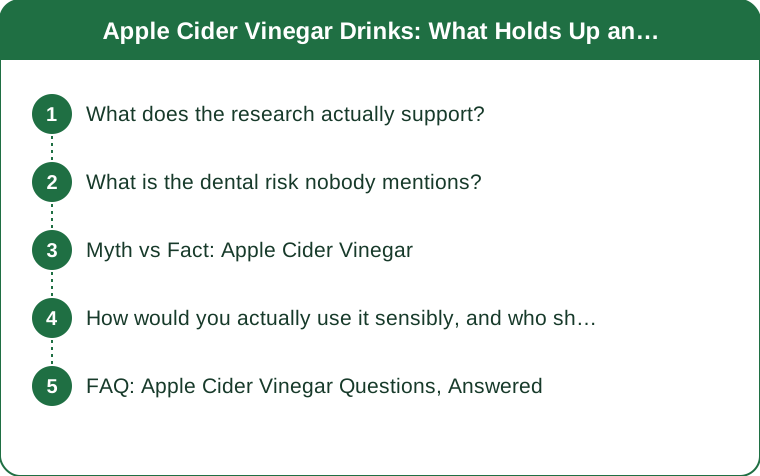
What does the research actually support?
One modest effect, reasonably consistently. Not much else.
The glucose effect is the strongest claim. Several small studies have found that vinegar taken with a carbohydrate-containing meal reduces the post-meal blood glucose rise, with the proposed mechanism being slowed gastric emptying and interference with carbohydrate-digesting enzymes.
The effect size is modest and the studies are small. These are typically short trials with few participants, and a modest blunting of one post-meal curve is not the same as changing anyone’s metabolic health. It is real, and it is small.
Timing matters if you use it for this. The effect requires the vinegar to be taken with or immediately before a carbohydrate meal. Drinking it on an empty stomach in the morning does not target the mechanism at all, which is exactly what most routines recommend.
On weight loss: a small number of trials have reported modest differences over weeks, and the effects are small and the evidence is not strong enough to treat this as a weight loss tool. No drink causes meaningful fat loss.
On cholesterol and blood pressure: limited and inconsistent, mostly small studies and animal work.
On detoxification: there is nothing here. Your liver and kidneys perform detoxification continuously and no drink assists them. This claim is marketing, not physiology.
On the mother: the cloudy sediment in unfiltered vinegar contains bacteria and yeast from fermentation. It is not a meaningfully studied probiotic and there is no good evidence it delivers the benefits attributed to it.
What is the dental risk nobody mentions?
Acid dissolves enamel, and enamel does not grow back.
Apple cider vinegar is strongly acidic, with a pH low enough to demineralise tooth enamel on contact. Dental erosion from acidic drinks is well documented, and vinegar is among the more aggressive of them.
Enamel does not regenerate. Unlike a cavity, which can be filled, erosion is permanent loss of tissue. Once thinned, it exposes the softer dentine underneath, causing sensitivity and discolouration.
A daily habit is exactly the pattern that causes it. Occasional exposure is buffered by saliva; repeated daily acid exposure over months and years is what erodes.
Undiluted shots are the worst version, and they remain a popular recommendation online. There are documented case reports of significant dental damage and throat irritation from this practice.
How to reduce the risk if you use it:
Dilute heavily — a tablespoon or two in a large glass of water, never neat.
Drink it through a straw so it bypasses the front teeth.
Drink it reasonably quickly rather than sipping over an hour. Prolonged sipping keeps your mouth acidic continuously, which is far worse than a brief exposure.
Rinse your mouth with plain water immediately afterwards.
Do not brush for at least 30 minutes. Brushing acid-softened enamel physically removes it, which turns a small exposure into real damage. This applies to all acidic drinks, including citrus and fizzy drinks.
Take it with food. Chewing stimulates saliva, which buffers acid.

Myth vs Fact: Apple Cider Vinegar
Myth: It detoxes your body. Fact: Detoxification is performed continuously by your liver and kidneys. No drink enhances that process, and the claim has no physiological basis.
Myth: It burns belly fat. Fact: Nothing targets fat in a specific region — that is not how fat metabolism works. The weight studies show small effects at best and nothing resembling targeted fat loss.
Myth: A daily morning shot is the way to take it. Fact: The best-supported effect requires taking it with a carbohydrate meal, so a fasted morning shot misses the mechanism entirely while maximising the dental exposure.
Myth: It alkalises your body. Fact: Blood pH is tightly regulated within a narrow range and food does not shift it. The alkaline diet premise is not supported, and vinegar is acidic in any case.
Myth: The mother makes it a probiotic. Fact: It contains fermentation bacteria and yeast, and it has not been shown to deliver documented probiotic benefits. Yoghurt, kefir, and kimchi have far better support.
Myth: More is better. Fact: Higher intakes increase the risk of dental erosion, throat irritation, and digestive discomfort, with no evidence of additional benefit.
How would you actually use it sensibly, and who should not?
As a small, optional addition to a meal. Not as a treatment.
If you want the glucose effect: one to two tablespoons diluted in a large glass of water, taken with or just before a carbohydrate-containing meal. Through a straw, rinse afterwards.
Better still, use it as food. Vinaigrette on a salad eaten with a meal delivers the same acid with the same meal, tastes better, involves no dental shot, and comes with vegetables. This is genuinely the superior version of the whole practice.
Treat it as a small optional extra. It does not replace anything that matters. A short walk after a meal has better evidence for the same glucose outcome, costs nothing, and carries no dental risk.
Who should be careful or avoid it:
Anyone on diabetes medication. Combining glucose-lowering effects without supervision can cause hypoglycaemia. Speak to your doctor first.
Anyone taking diuretics or medication affecting potassium, since there are case reports of low potassium with very high intakes.
Anyone with reflux, gastritis, or ulcers. Acidic drinks commonly aggravate these.
Anyone with gastroparesis or delayed gastric emptying, since slowing emptying further is the last thing wanted.
Anyone with existing enamel erosion or dental sensitivity, who should ask a dentist first.
And a seasonal note: as the weather cools, warm wellness drinks replace cold ones for most people — and adding vinegar to a hot drink increases contact time in a warm mouth, which is worse for enamel, not better. Keep it cold, quick, and with food.
This is general information, not medical advice. Anyone with a medical condition or on medication should speak to a healthcare professional before adding it to their routine.
FAQ: Apple Cider Vinegar Questions, Answered
Does apple cider vinegar help with blood sugar?
There is modest evidence that vinegar with a carbohydrate meal reduces the post-meal glucose rise. The studies are small and the effect is real but limited, and it requires taking it with the meal rather than fasted.
Will it help me lose weight?
Evidence is weak. A few small trials report modest differences, and nothing supports it as a meaningful weight loss tool. Diet quality, protein, and activity do far more.
Is a daily shot safe for my teeth?
Undiluted shots are the main way people damage enamel, and erosion is permanent. Always dilute heavily, use a straw, rinse with water, and do not brush for at least 30 minutes.
When should I take it?
With or just before a carbohydrate-containing meal, if the glucose effect is what you want. A fasted morning shot misses the mechanism while maximising acid exposure — and a vinaigrette on a salad achieves the same thing more pleasantly.
TL;DR:
- The one reasonably supported effect is a modest reduction in post-meal glucose when taken with a carbohydrate meal.
- Detox, targeted fat loss, and alkalising claims have no physiological basis.
- Dental erosion is the real, documented risk, and enamel does not grow back — dilute, use a straw, rinse, and never brush for 30 minutes.
- Diabetes medication, reflux, and existing enamel problems are all reasons to ask a professional first.
Put it on a salad instead of in a glass. Same acid, same meal, better dinner, no shot.
Keep Reading
This article is for general informational purposes only and is not medical advice. Always consult a qualified health professional for guidance specific to you.