What Actually Happens to Your Green Juice Overnight in the Fridge
Quick Answer: The main losses overnight are vitamin C and some polyphenols to oxidation, plus separation and flavor change — and the biggest driver is headspace air in the container, not time in the fridge. A juice filled to the brim in a sealed, opaque or dark container, kept cold, holds up substantially better than the same juice in a half-empty jar. Expect meaningful vitamin C loss over 24 to 48 hours, and much less loss in most minerals and fiber.
You made a beautiful bright green juice on Sunday and by Tuesday it is a slightly sad khaki color with a layer of water on top.
Something did happen — and it is less dramatic than the internet claims and more fixable than most people realize. The third section is where the actual technique is.
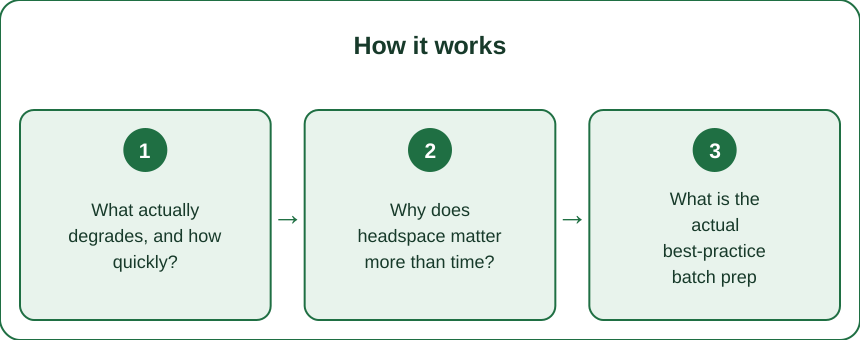
What actually degrades, and how quickly?
Different components have very different fates, which is why blanket claims are unhelpful.
Vitamin C — degrades fastest. Ascorbic acid oxidizes readily in the presence of oxygen, and the process accelerates with light, heat, and certain metal ions. In refrigerated fresh juice, meaningful losses accumulate over 24 to 72 hours, with the rate depending heavily on how much air the juice is in contact with.
Polyphenols and some antioxidants — degrade moderately. Many of the compounds responsible for color and bitterness in greens and berries oxidize over a day or two. This is what you are seeing when a bright green turns dull.
Chlorophyll — changes color. Chlorophyll degrades in acidic conditions to a compound with a distinctly olive-brown tone. If your juice contains lemon or apple, the acidity is driving that shift. It is a color change more than a nutritional collapse.
Minerals — essentially unchanged. Potassium, magnesium, calcium and the rest do not oxidize away. A three-day-old juice has the same mineral content as a fresh one.
Fiber, in blended drinks — unchanged. Smoothies retain their fiber regardless of storage.
Flavor — changes noticeably. Bitterness often increases in green juices, and enzymatic reactions continue. This is usually the reason people stop drinking their batch, not the nutrition.
And a food safety note that matters more than the nutrient question: fresh unpasteurized juice supports bacterial growth. Keep it cold, use it within about 48 to 72 hours, and discard anything that smells fermented or fizzy.
Why does headspace matter more than time?
Because oxidation requires oxygen, and the oxygen in your container is a fixed, measurable amount.
A jar filled to the brim contains very little air. A half-full jar contains a substantial volume of oxygen sitting in direct contact with a large surface area of juice, and that oxygen gets consumed by oxidation reactions.
Practical consequence: two identical juices, same fridge, same 24 hours — the one in a full sealed jar retains noticeably more of its vitamin C and its color than the one in a half-empty bottle.
This is why the single most effective storage technique is not a special container — it is portioning. Fill several small jars completely rather than one large jar partially. Each portion sits full and sealed until the moment you drink it.
Three practical implications:
Choose container size to match your serving size. A batch split into four full 250 ml jars keeps far better than the same batch in one 1-litre bottle you open four times.
Every time you open a container, you reset the clock. Pouring a glass and returning a half-full bottle to the fridge introduces a full charge of fresh oxygen.
Filling to the very top genuinely matters — right to the rim, so the lid displaces the last of the air. It looks fussy and it is the highest-return step available.
Light matters too, secondarily. Light accelerates the degradation of several sensitive compounds. An opaque or dark container, or simply keeping jars at the back of the fridge rather than in the door, helps — and the fridge door is also the warmest part of the fridge, so it loses on both counts.
What is the actual best-practice batch prep routine?
Six steps, and it takes no longer than what you are already doing.
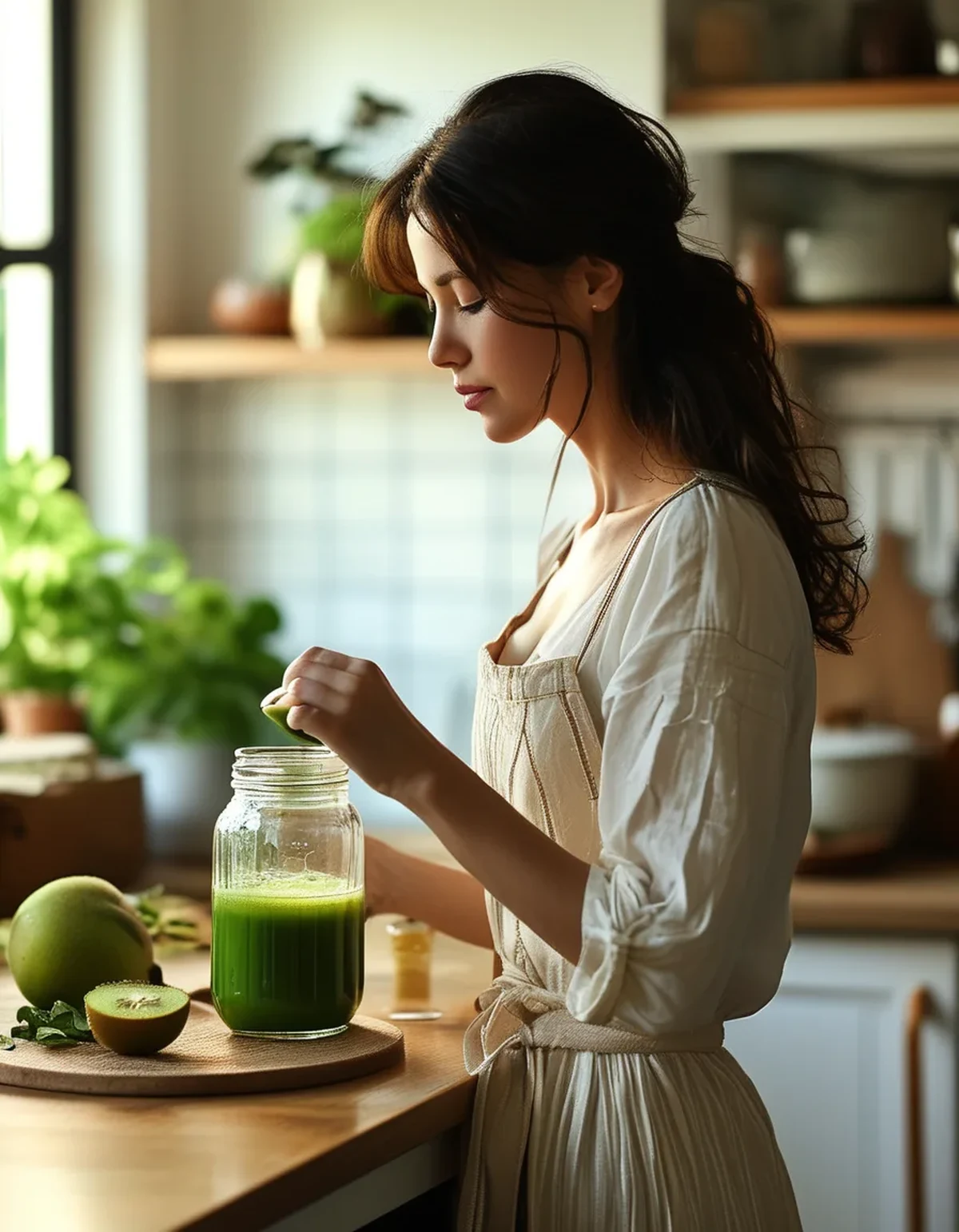
1. Chill your produce before juicing. Starting with cold ingredients means the finished juice reaches fridge temperature faster. Warm juice spends its first hour in the temperature range where degradation is fastest.
2. Add acid deliberately. Lemon or lime juice does two useful things: ascorbic acid is itself an antioxidant that is preferentially oxidized, sparing other compounds, and lower pH slows enzymatic browning. It is why apple juice with lemon stays paler. Half a lemon per litre is enough to matter.
3. Fill containers completely, seal immediately. As above. To the rim.
4. Use glass where you can. Glass is non-reactive, does not hold odors, and does not scratch — scratched plastic has more surface area and holds residue. Glass is also easier to sanitize properly, which matters for the food safety side.
5. Store at the back of the fridge, not the door. The back is colder and darker, and both help.
6. Use within 48 to 72 hours, and shake before drinking — separation is gravity, not spoilage.
One optional extra: if you have a vacuum-sealing container or a vacuum wine stopper that fits your jar, removing headspace air directly is more effective than any other single intervention. It is not necessary, and it does work.
What does not help: freezing and thawing damages texture and does not preserve flavor well, and adding vitamin C powder is redundant if you are already using citrus.
Myth vs Fact: juice storage claims
Myth: Juice loses all its nutrients within 20 minutes of being made.
Fact: This claim gets repeated constantly and is dramatically overstated. Some vitamin C degradation begins immediately, but the losses over 20 minutes are small. Minerals, fiber in smoothies, and many phytonutrients are essentially stable. A juice you made this morning and drank at lunch is still a perfectly good juice.
Myth: Cold-pressed juice keeps much longer than blended juice.
Fact: Cold-pressed juice generates less heat and less aeration during extraction, which does help. But once it is in a container, the same storage rules apply — headspace, light, and temperature dominate. Cold-pressed juice in a half-empty jar in the fridge door does worse than centrifugal juice in a full sealed jar at the back.
Myth: If it separates, it has gone bad.
Fact: Separation is normal and expected. Solids settle. Shake it. The actual signs of spoilage are a fizzy or fermented smell, visible mold, a bulging lid, or an off taste — not layers.
Myth: A dark color means the nutrients are gone.
Fact: Color change tracks oxidation of pigment compounds and acidity effects, which correlates loosely with some nutrient loss but is not a measure of it. A juice with lemon in it browns less and a green juice goes olive because of pH, not because it is worthless.
FAQ: Batch Prep Questions, Answered
How long is fresh juice actually safe to drink?
Refrigerated fresh juice is generally recommended within 48 to 72 hours, kept consistently cold. Unpasteurized juice can support bacterial growth, which is why food safety guidance advises particular caution for young children, pregnant people, older adults, and anyone immunocompromised. When in doubt, throw it out — and if it smells fermented or the lid has bulged, do not taste it. This is general information, not medical advice.
Is a smoothie better than a juice for batch prep?
For storage, mostly yes. Smoothies retain their fiber, which slows nothing about oxidation but means the nutritional profile is more robust to it, and the thicker texture reduces separation. They do brown more visibly, particularly with banana or apple. Adding citrus helps both.
Does it matter what time of day I drink it?
Less than most content suggests. Timing effects on absorption exist for a few specific nutrients — iron absorption is affected by tannins in tea, and some fat-soluble compounds absorb better with a meal containing fat. For a general fruit and vegetable juice, the meaningful variable is that you drink it at all, and that it is still cold and fresh when you do.
TL;DR:
- Vitamin C and some polyphenols oxidize over 24 to 72 hours; minerals and fiber are essentially stable.
- Headspace air matters more than elapsed time — a full sealed jar beats a half-empty one decisively.
- Portion into serving-sized containers filled to the rim rather than one large bottle you keep reopening.
- Add citrus, chill produce first, use glass, store at the back of the fridge rather than the door.
- Separation is gravity; fizzy smells, bulging lids, and off tastes are the actual spoilage signals.
The reason it is worth knowing which parts degrade is that it lets you stop feeling like batch prep is a compromise. Split into full jars with a squeeze of lemon, kept properly cold, a Sunday batch on Tuesday is a genuinely good drink — just a slightly less photogenic one.
Keep Reading
This article is for general informational purposes only and is not medical advice. Always consult a qualified health professional for guidance specific to you.